

About tarotgraphe
crafting tarot as they were during the XVII and the XVIII th century is our mission.
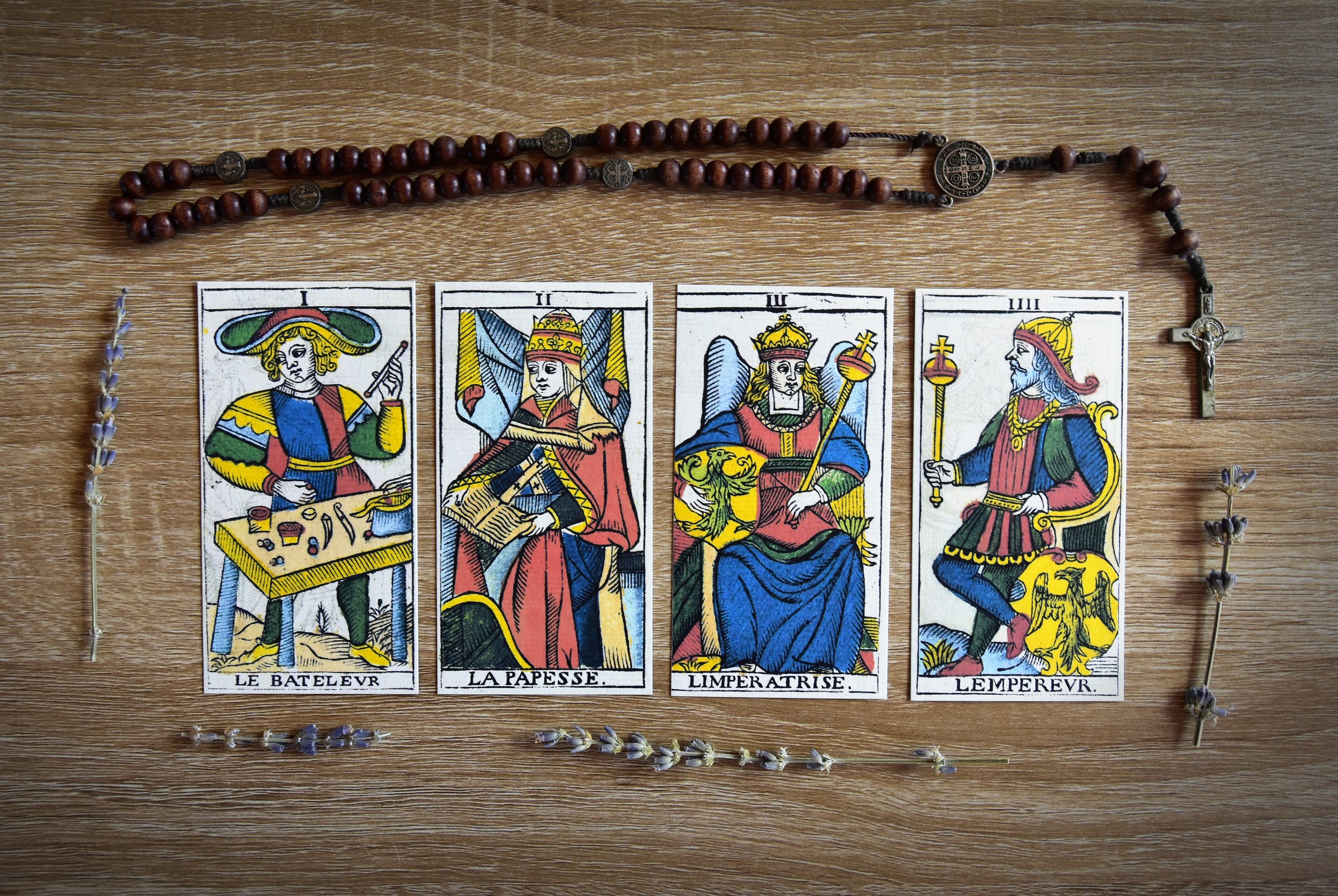
Tarotgraphe is one of the lasts ‘‘Artisan Cartier’’ producing handcrafted Marseille tarot decks using historical techniques. Alongside faithful reproductions, we also recreate forgotten playing card decks that have disappeared from the market for centuries.
Our mission is to offer historical Marseille tarot decks that are as faithful as possible to those sold by master cardmakers during the 17th and 18th centuries.
To achieve this, we seek out rare Marseille tarots and other historical playing cards preserved in museums and private collections, giving priority to decks that have never or only rarely been republished.
By bringing these forgotten works back to life, we hope to broaden the range of historical Marseille tarot available today and give collectors, historians, and enthusiasts the opportunity to discover decks that have remained inaccessible for generations.
☩ our production method ☩
☩ research of new tarot ☩
The very first step consists in researching a new Marseille tarot to restore.
For that step, I contact museums and private collectors to ask them if they have some interresting decks in their collection.
If they do, then, I have to negotiate the terms of the contract of reproduction to obtain the right to commercialize this new tarot.
When terms of contract are negotiated, I have to take pictures of the deck or asking them to take pictures if the museum is too far away from me.

☩ The restoration ☩
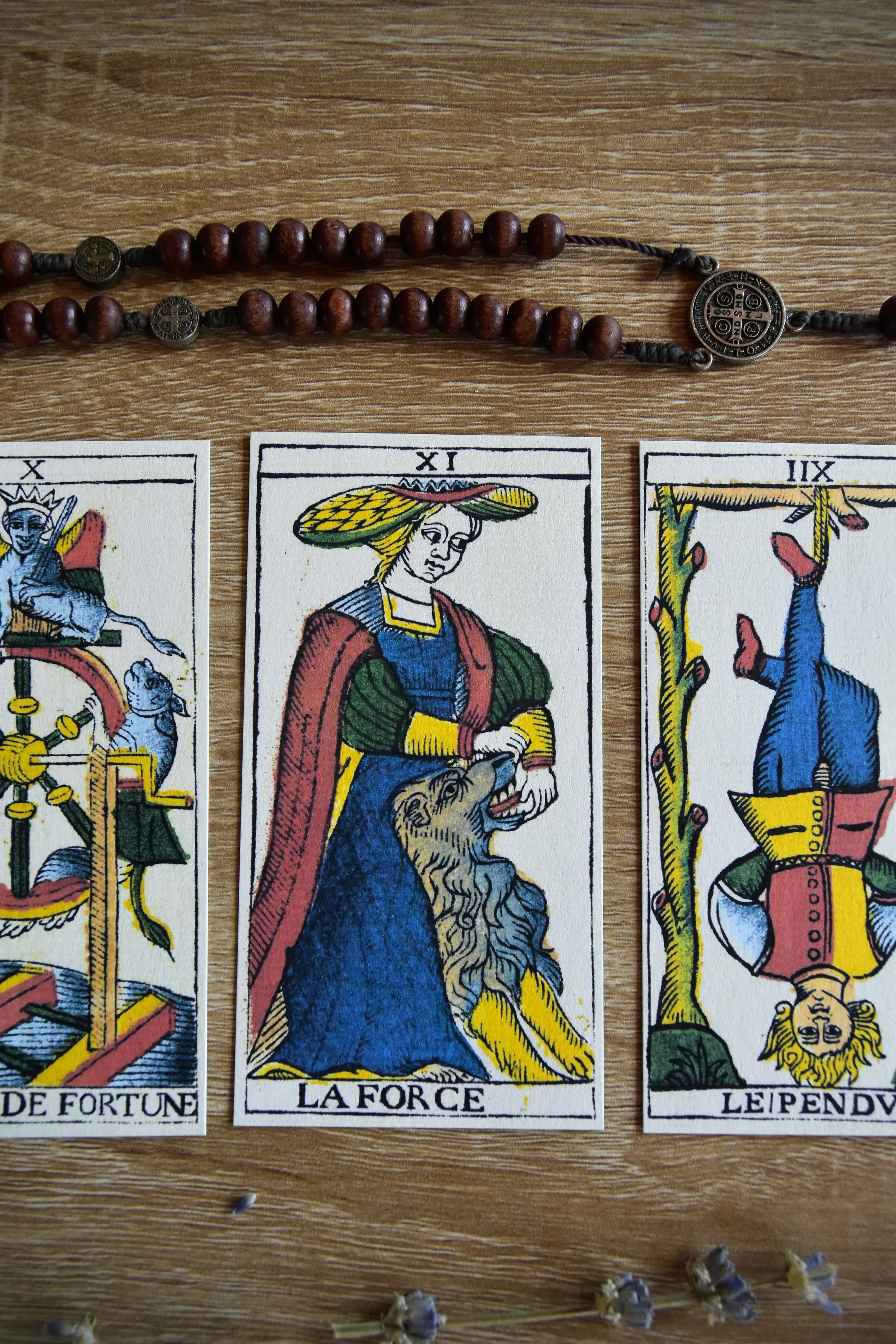
The second step is to restaure the deck using Adobe Photoshop.
Decks are integrally restored according to our knowledge in history of art.
Each line and contour are meticulously reconstructed, and colors included the black ink are restored to their original tones, as they appeared when the deck was first produced in the 17th century.
In most cases, the original black ink used for the contours has turned brown or blue over time; the green, and sometimes the blue, has become darker, the yellow has turned orange, and the cyan has turned grey.
Sometimes, certain letters, names, and faces have been completely lost to time, requiring careful reconstruction.
I also meticulously repair holes, burn marks, and areas of moisture damage in the paper.
Manufacturing imperfections present in the original decks such as damaged woodblocks, poorly applied paint, or areas accidentally left unpaintedare preserved in order to faithfully respect the authenticity of these tarot decks.
☩ HD PRINTING ☩
The next step is the high-definition printing of the restored artwork. This delicate process is carried out entirely in our workshop using professional-grade printing technology, chosen to reproduce with exceptional precision the colours, fine details, and character of the original decks.
The face and back of each card are printed separately, each on its own carefully selected sheet of paper.
This traditional approach allows us to preserve the distinctive structure of these historic decks while achieving the highest possible level of detail and fidelity.
☩ the paper ☩
The paper is an essential part of our approach to historical reconstruction. We use a traditional handmade French cotton laid paper, carefully selected for its weight, natural texture, and characteristic laid lines.
Unlike the smooth and uniform papers commonly used today, this type of paper retains the distinctive tactile quality of traditional papermaking. Its appearance is inspired by the papers used by the maîtres cartiers of Provence during the 17th and 18th centuries, helping us remain faithful not only to the original artwork, but also to the material character of historic Tarot decks.
The result is a paper with a subtle, authentic texture that complements the restored artwork and gives each deck the feel of a truly traditional Tarot.
☩ Traditional “contre-collage” ☩
Once the face and back of each card have been printed separately, the two sheets are carefully glued together by hand using a homemade starch-based paste.
The paste is applied to the surface of each sheet before they are meticulously joined together. Each card is then carefully pressed and smoothed to remove any air trapped between the two sheets, while any excess paste that may escape from the edges is removed with a cloth.
This meticulous process gives each card its proper thickness, rigidity, and traditional feel, while remaining faithful to the artisanal methods of historic cardmaking.
☩ cardboard making ☩
This step is crucial for your deck to be solid and to remain in good shape for a very long time. Once each card of your deck is glued, we put the pile inside one of our iron press. We put a very low pressure at first.
We set a timer for 15 minutes, then we had a bit more pressure and set the timer for another 15 minutes. We repeat that process until the iron press reached the maximum level of pressure.
Required time : 24 hours to enhance the glueing step.
☩ the drying ☩
Once the first iron press step is completed, we separate each sheet of handmade cotton paper from the regular sheet of paper used for protection. We then hang each sheet individually, allowing it to dry fully and evenly.
This step is essential to ensure that the paper regains its natural rigidity and remains perfectly flat before the next stage of the process.
Required time: 24–48 hours of drying (an additional day may sometimes be required, depending on the weather. During the rainy season, humidity can be extremely high, causing certain stages of the process to take longer).
☩ the traditional smoothing ☩
Today, most modern Tarot decks are finished with plastic lamination or varnish to protect the cards, make them thicker, and give them a smooth, slippery surface. During the 17th and 18th centuries, however, plastic lamination did not exist. Cardmakers used a completely different method: they applied Marseille soap (savon de Marseille) to the surface of the cards, then carefully smoothed it with a stone. This long and meticulous operation—approximately 10 minutes per card—not only protected the cards, but also enhanced their colours, gave them a pleasant touch, and left them with the distinctive, subtle scent of Provence, thanks to the olive oil traditionally used in Marseille soap.
Once the soap has dried, it forms a fine, wax-like protective layer on the surface of the card. Unlike a modern coating, it does not need to be reapplied: when properly made, this finish is remarkably durable and can remain on the cards for a lifetime. For us, this traditional treatment is much more than a protective finish. It gives the cards a particular character and soul, creating a tangible difference between an industrially manufactured deck and a genuinely handcrafted Tarot deck. This is why we use natural Marseille soap made with olive oil, produced in Marseille, for our handcrafted cards.
Once all the sheets are perfectly dry, we can begin the smoothing process. We first heat the oven to approximately 170°C, then carefully stack the sheets of paper together, protecting the top and bottom with thick regular paper. The temperature of the paper is checked by hand throughout the process. It needs to become hot enough for the soap to melt and glide properly across the surface. Florent has considerably more resistance to heat than I do, so when I touch the paper and think, “That's hot enough!”, he usually answers: “Hmm… not yet. It needs to really burn.” Florent therefore performs this step 99% of the time.
The temperature is crucial. If the paper is not hot enough, the soap will not glide properly and the process can take considerably longer. On one occasion, it took 25 minutes for a single card simply because the paper had not reached the right temperature. Conversely, if the paper is not heated sufficiently, the soap will not properly adhere to the surface, and the protective finish will not develop as it should. Traditional smoothing is therefore one of our main signatures, but also one of the most demanding stages of the entire process. It requires patience, experience, and precise control of temperature to reproduce this characteristic finish and achieve a result designed to last.
Required time: approximately 4 hours for a full deck.
☩ IN THE IRON PRESS AGAIN ☩
Once the deck is has been laminated, we need to put it again in the iron press so each card is totally flat. The heating process for smoothing then do deform the paper so this step is a must and it can last quite long!
Required time : 72 hours (minimum). It can last up to 7 days, depending on humidity level
☩ the HAND-CUttING ☩
The deck is then hand-cut, one card at a time, using a guillotine cutter.
Each individual card is carefully aligned and cut by hand to ensure a clean and precise result.
This meticulous operation requires great attention and precision, as even the slightest mistake can compromise the entire deck.
If a card is cut incorrectly, the process must be started again from the beginning.
☩ ROUNDED CORNERS ☩
Originally, most Tarot cards were made with square corners. Rounded corners appeared later in the history of playing cards. Square corners have a more elegant and traditional appearance, but they are also more fragile and more prone to damage with repeated handling.
For those who prefer rounded corners, we offer a subtle 3 mm radius, carefully chosen to preserve the traditional appearance and authenticity of the deck while providing greater resistance to everyday handling.
Each of the 78 cards is rounded individually by hand, one card at a time. This operation takes at least 1 hour and 30 minutes for a complete 78 cards deck.
☩ the packaging ☩
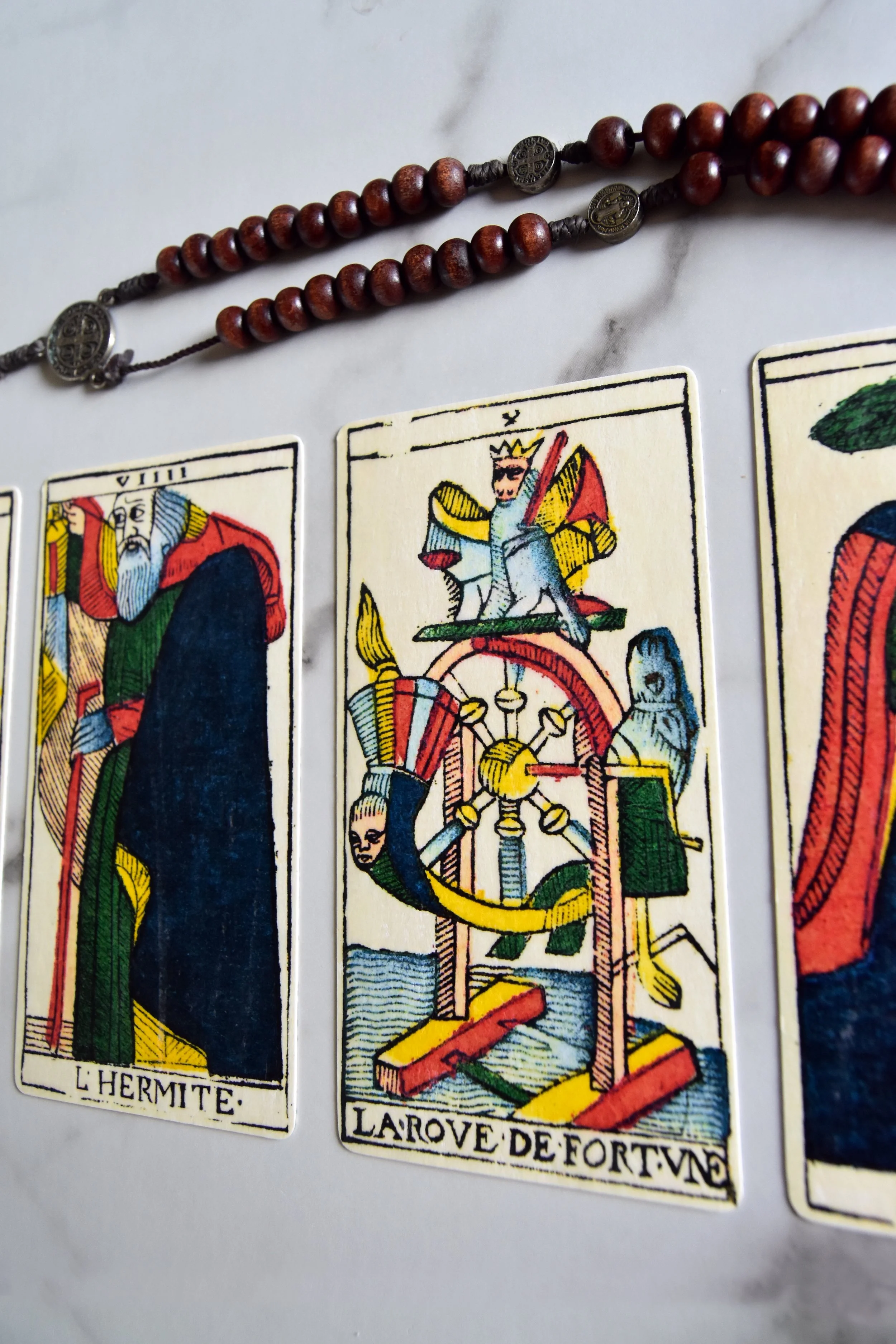
When the deck is ready, you can choose to have it traditionally wrapped in a cardmaker’s envelope, as was done in the past, or opt for a handcrafted box made with care.
Our handcrafted boxes are handmade, hand-painted, and varnished for lasting protection.
As each box is made entirely by hand, no two are exactly alike, giving every deck its own unique design and character.
Finaly, To create a full 78 cards deck, it takes between 7 and 14 days (depending the weather and options selected)
☩ the blessing ☩
In order for your decks to be invested by the purified, each handcrafted deck is blessed before shipping.
Our blessing, is made accordingly to the “Roman Benedictional”, the aim is to energetically cleanse your decks and to invest them with the Holy Spirit so the love and goodness of God may be manifested through your Marseille tarot.
This blessing also protects your tarot from demonic influences and evil spirits.
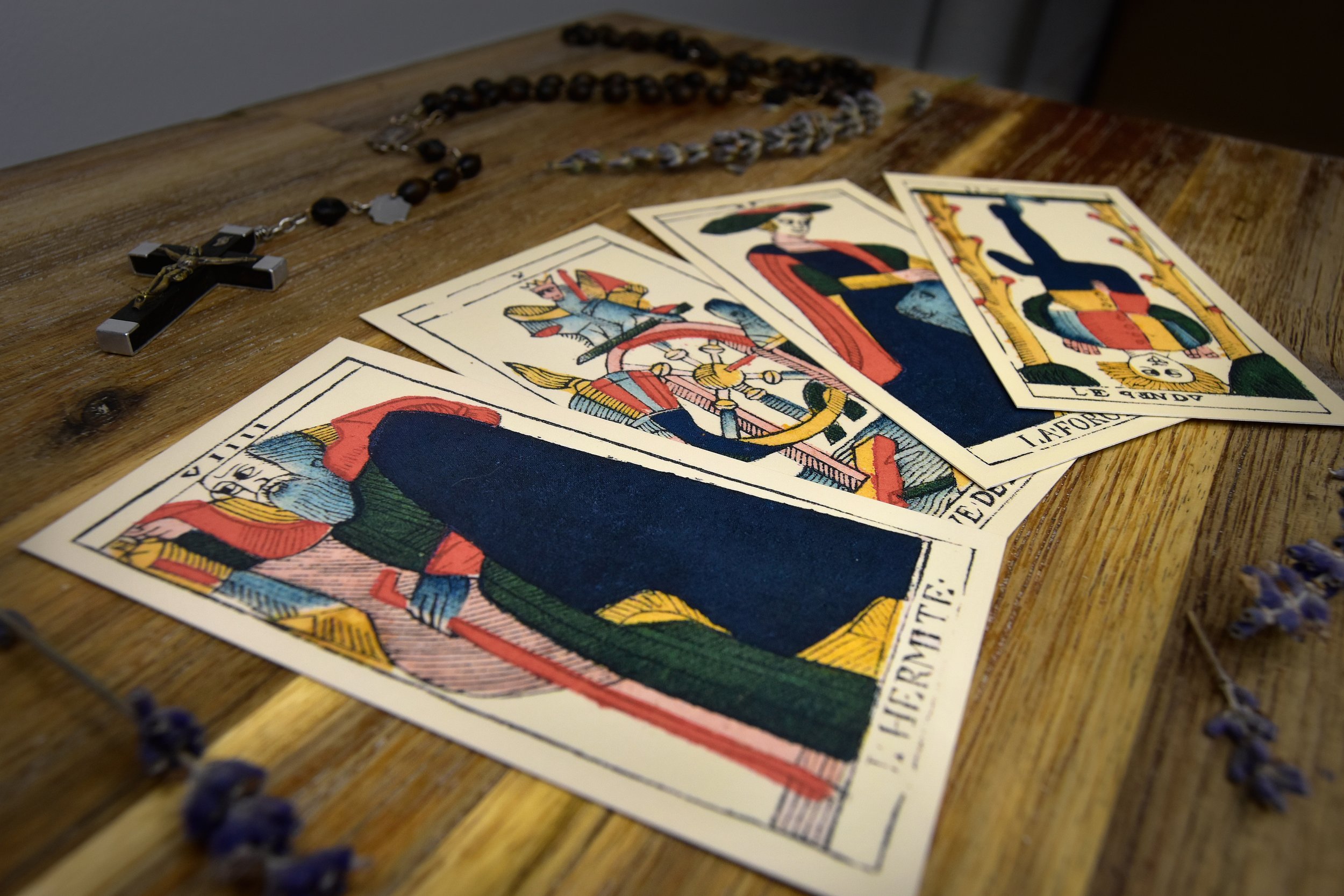
our manufactured decks
Tarotgraphe also offers high-quality manufactured decks at a very competitive price (€22 for a 22-trump deck and €39 for a 78-card deck), making our tarot decks more accessible while allowing a wider audience to discover, experience, and partake in this rich tradition.
Today, most tarot decks are printed in China because of the very competitive prices offered by large-scale manufacturers. However, producing so far from where the decks are sold does not fit with our values, as we believe it raises important environmental and ethical concerns.
This is why we have chosen to have our manufactured decks produced in a small factory in Aix-en-Provence, even though local production comes at a higher cost. This allows us to maintain shorter supply chains and a more sustainable approach to production, while also making it possible for those who cannot afford our handmade decks to support our work and contribute to our efforts to keep this tradition alive.

about us

☩Who are we ?☩
Tarotgraphe is a small family business owned by Roxane and Florent GIRAUD.
Our workshop is inside our house in San Pedro (Belize).
Florent has been a passionate collector of historic Tarot de Marseille for almost ten years. He is in charge of the restoration work and the production.
After studying history of art during 3 years, it was in 2023 that he gave birth to “Tarotgraphe”, a company specialized in the restoration and the publishing of old Marseille tarot.
Since 2024, Roxane joined the team, she is in charge of the customer service and she is also in charge of the production
Why I created “Tarotgraphe”
“It was in seeking to acquire certain Tarots de Marseille that were not present on the market that I came up with the idea of setting up my own company to reissue old Tarot.
Particularly fond of the Tarots of Marseille type 1, Tarotgraphe is specialized in the restoration and marketing of this type of tarot.
If the Tarots of Marseille type 2 are today marketed en masse, the offers concerning the Tarots of Marseille type 1 are much rarer and come to lack.
That is why I decided to compensate for this deficiency by giving birth to Tarotgraphe.”