
The ethics of the maitres cartiers
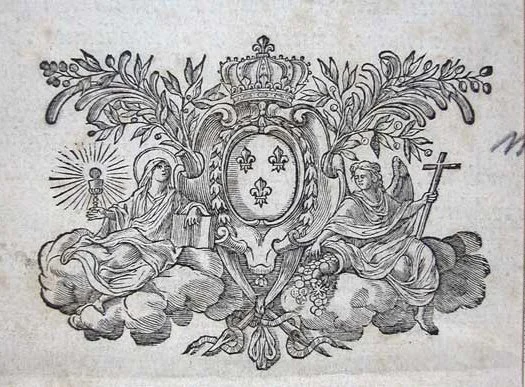
Logo de l’imprimerie royale
Although today the craft of the “maitres cartiers” may seem to have no connection with Catholicism in the minds of most people, this was not always the case.
Under the Ancien Régime, practising the craft of a “maîtres cartiers” involved far more than simply making playing cards.
It was also a solemn commitment to one’s professional community, entailing a responsibility towards one’s trade and the community to which one belonged. To attain the rank of “master”, one had to obtain the status of a master craftsman, which notably allowed one to work independently and run one’s own workshop.
Among other requirements, applicants had to provide a Catholic baptismal certificate and swear an oath on the Gospels, solemnly pledging to observe the rules of the trade and fulfil their obligations faithfully. The quality of one’s workmanship, respect for the regulations, and the honour of the profession went beyond the artisan’s personal interests; they were part of the duties of one's state in life as understood in Catholic teaching.
In a society deeply permeated by the Catholic faith, this oath gave professional commitment a religious dimension : the master cardmakers’s word was spoken under the gaze of God and bound his conscience as much as his reputation.
A “maitre cartiers” knew that his eternal salvation was at stake if he broke his oath, and therefore took great care to honour it.
This helped prevent any deviation from the proper practice of the profession, thereby perpetuating the tradition by preserving it as it had been handed down by previous generations.
Thus, the philosophy and theology that permeated each deck remained intact for several centuries. This continuity prevented the creation and dissemination of playing card decks conveying philosophies considered dangerous, as they could lead man away from God and from its heritage and distort the Marseille tarot.
Under this system, the Marseille tarot could not be infused with influences from other religions, sects, secret societies or cultures, as it often is today, thus preserving the sacred character of this Western art.
This concern for preserving a tradition and preventing its distortion was by no means unique to the West. In several Asian cultures, sacred arts and religious practices are likewise governed by established rules intended to ensure their faithful transmission across generations. Tibetan Buddhist thangka painters, for instance, followed traditional iconographic conventions rooted in religious teachings, while Taoist ritual manuals sought to regulate ceremonial practices and guard against inappropriate alterations or mixtures of traditions. These examples illustrate a principle shared by many civilizations: preserving an inherited tradition meant more than merely reproducing its outward forms; it also meant safeguarding the teachings and meanings it was intended to convey.
Unfortunately, in the wake of the Masonic Revolution of 1789, France was corrupted by modernity, leading to a gradual break with our ancestral traditions and cultural heritage.
Today, much of this rich heritage has been forgotten or even lost. I believe it is our responsibility, as the present generation, to revive this legacy, rediscover it, and pass it on to future generations.
This break with tradition has not, however, followed the same course in every civilization. Several Asian cultures have succeeded in preserving their spiritual and cultural heritage intact by maintaining close ties with the religions handed down by their ancestors. For religion is not merely a dimension of individual life; it is also one of the foundations upon which civilizations are built and perpetuated.
While the rules governing the profession of “maîtres cartiers” under the Ancien Régime may today be perceived by Westerners as a restriction on individual freedom, I see them instead as an essential safeguard of our heritage. In several Asian cultures, respect for rules handed down through tradition remains a fundamental value, not because such rules are seen as restricting individual freedom, but because they are regarded as essential to the stability and continuity of civilization.
As an artisan cartier I believe it is important to be a practising Catholic in order to follow in the footsteps of our predecessors and thus perpetuate the tradition by preserving it as it was handed down to us.
I also believe that it is essential to reconnect with our ancestors’ mindset, beliefs, and worldview in order to truly understand their art and reproduce it faithfully, without allowing it to be distorted by the influence of modernity.
Even today, I believe that the craft of the “maitres cartiers” is more than just a profession; it is a true vocation, one that should permeate every aspect of our lives, whether professional, personal, or spiritual.