
evolution of ink & painting
Hello everyone,
Many of you have asked me in private about the ink used by the maîtres cartiers of my native Provence. Some of you were surprised to learn that the ink originally used for printing tarot cards was a deep, rich black, rather than the brownish or greyish colour we often see today. This change in appearance is the result of centuries of ageing, which have gradually altered the ink.
In Provence, during the 17th and 18th centuries, printmaking workshops, not just those of the maîtres cartiers, used oil-based printing ink. The pigment was carbon black, obtained by burning organic materials. This was then mixed with a drying oil, typically linseed oil that had been heated to improve its drying properties. The oil acted as a binder, allowing the pigment to adhere to the paper and dry while retaining its deep black colour.
The result was a thick, greasy black ink that, over time, tended to flake and wear away through repeated handling and shuffling. This is why we can still observe tiny gaps and holes in the printed lines of antique tarot decks today.
Below is an example of a print made using oil-based ink by Atelier du Pib, a contemporary printmaker based in Avignon, Provence. It gives you an idea of the appearance of this type of ink before centuries of ageing gradually caused it to fade, turn brownish or greyish, and flake away, leaving the tiny holes we can now observe in the printed lines of antique decks.
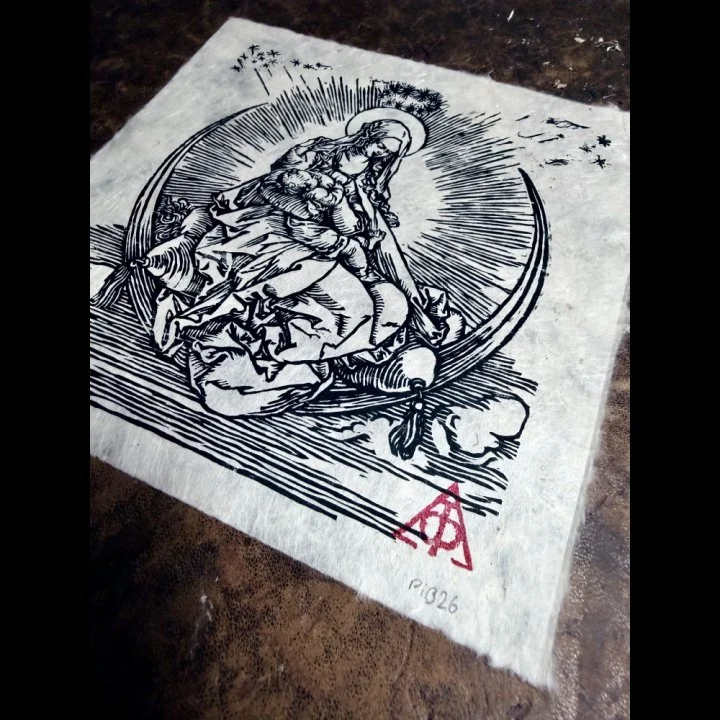
Engraving by l’Atelier du Pib : www.atelierdupib.fr
As for the paints, my ancestors primarily used lead-tin yellow, a pigment made from a mixed oxide of lead and tin, which were heated together to produce a very bright, vivid yellow. Unfortunately, this pigment tends to turn orange or ochre over time.
For green, they mainly used green earth, extracted from natural deposits of clay rich in iron-bearing minerals, particularly celadonite and glauconite, which were then washed and ground. This rather dark green tends to become even darker over time.
For red, we mainly find madder lake, obtained by extracting the red dye from madder roots and fixing it onto a mineral substrate, usually alum. This produces a very vivid red that also tends to darken slightly over time.
For purple, they either used vermilion, a pigment made by combining mercury and sulphur to form red mercury sulphide, or mixed blue and red paints.
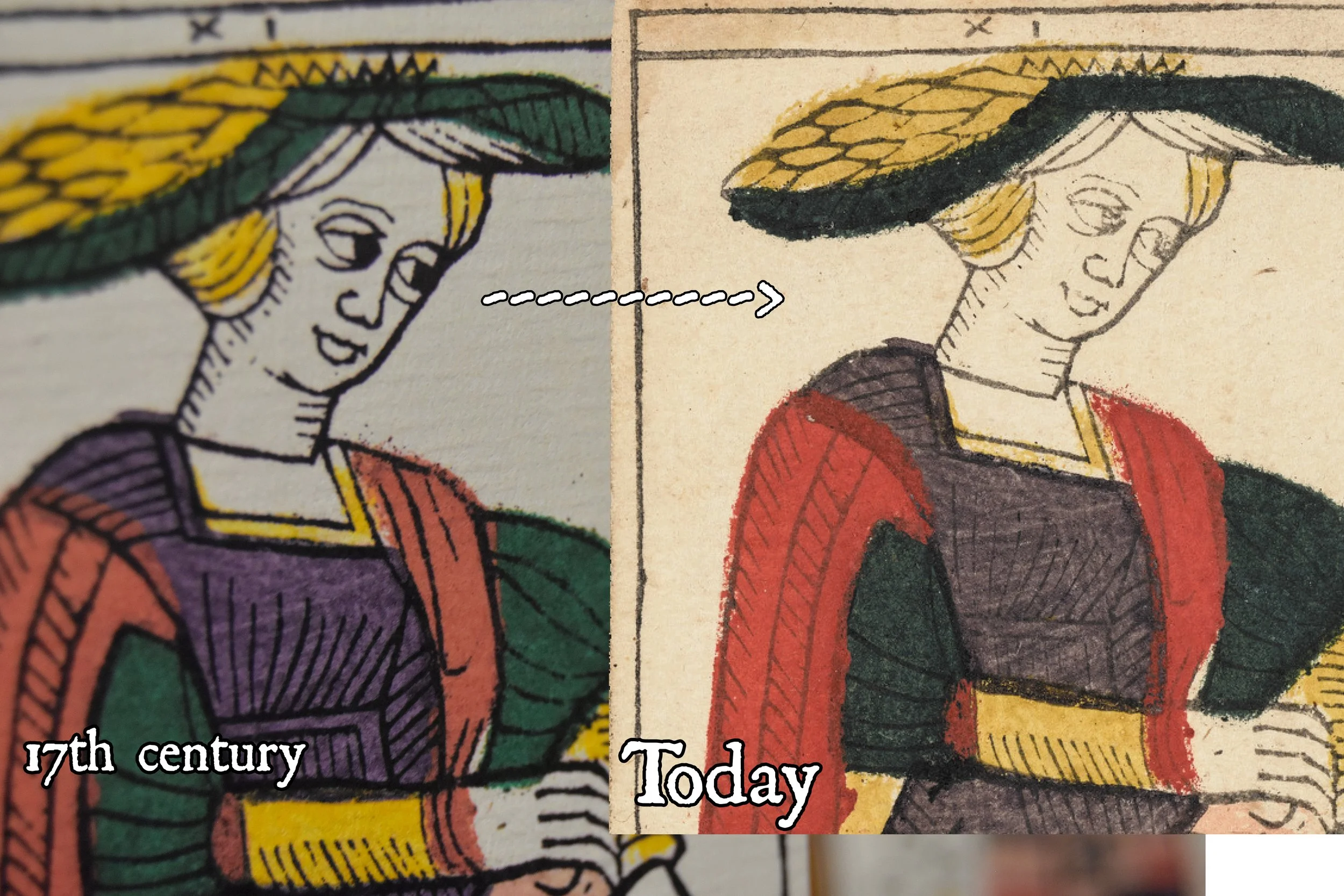
Evolution of ink (Philippe Vachier)
As for light blue, blue verditer was commonly used. This blue pigment was made from copper compounds through chemical precipitation, then washed and ground. Unfortunately, it tends to lose its brilliance and become greyish over time.
Restoration consists in restoring a work of art in its entirety, exactly as it was before the passage of time altered it. To recover a work's original state, it is essential to identify the pigments used in a particular period and place, in order to understand how the inks and pigments may have changed over time. This preliminary research is necessary to recover the original colours and reproduce them.
This essential preliminary work is what distinguishes a fully restored work from a facsimile, which may or may not have been modified or improved in comparison with the original.
I hope this answers your questions
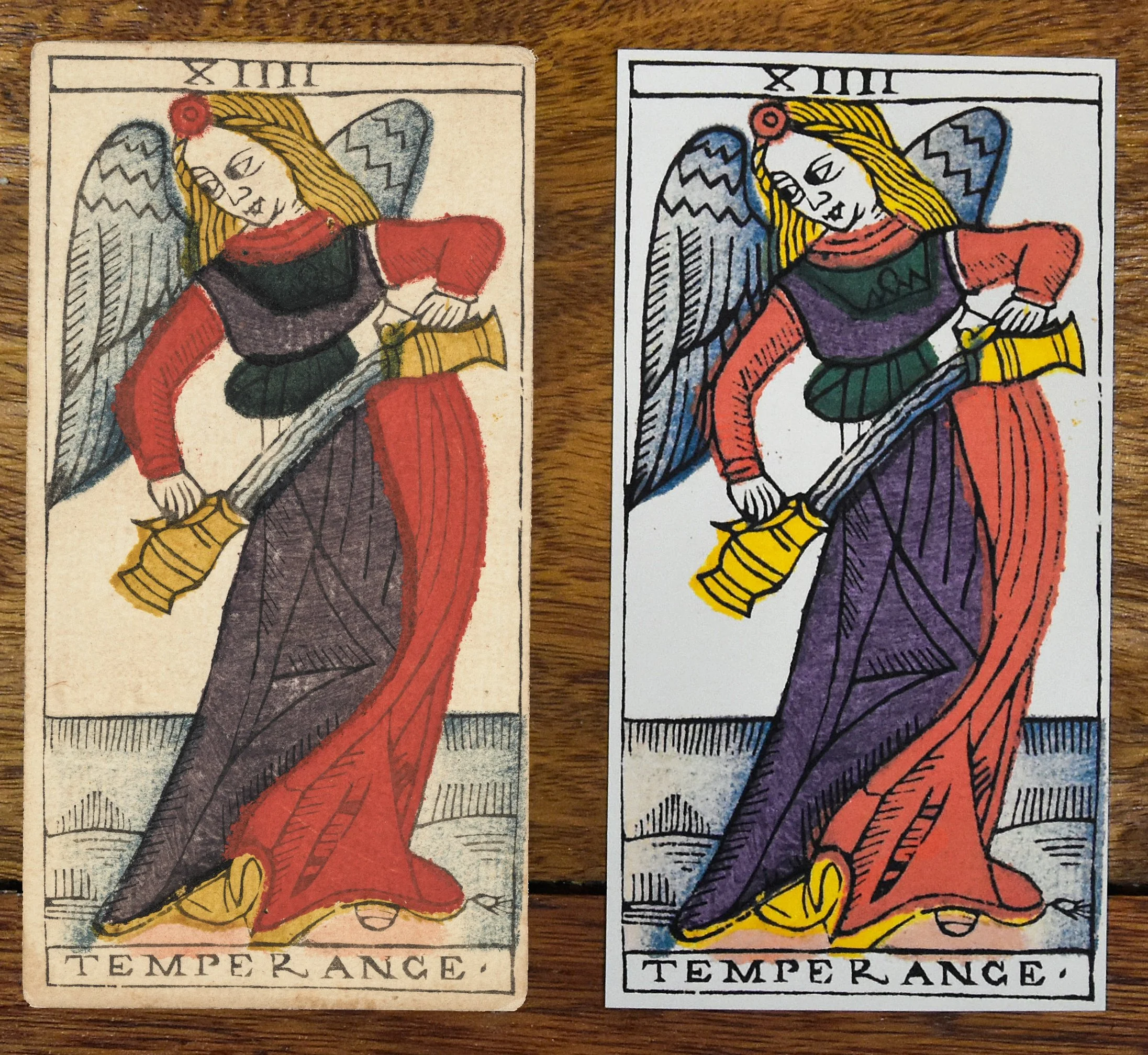
Evolution of ink and painting (Temperance from Philippe Vachier Marseille tarot)